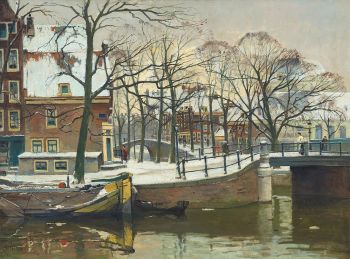
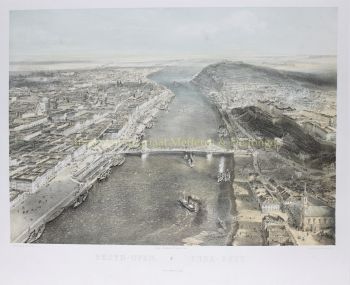
Amsterdam, Prinsengracht - Jan Schenk after Abraham Rademaker, ca. 1720 by Artista Desconocido
Scroll to zoom, click for slideshow

Amsterdam, Prinsengracht - Jan Schenk after Abraham Rademaker, ca. 1720 1720

Artista Desconocido

55 ⨯ 94.50 cm
€ 4.850

Inter-Antiquariaat Mefferdt & De Jonge

  • Sobre la obra de arte
    BEAUTIFUL VIEW OF THE PRINSENGRACHT IN AMSTERDAM "Gesicht van de Groen-markt, van de Ree Sluys te sien naar de Wester Kerk tot Amsterdam" [View of the vegetable market, from the Reesluis towards the Westerkerk in Amsterdam.] Etching with engraving on two sheets made by Jan Schenk after the design of Abraham Rademaker and published by Leon Schenk around 1720. Coloured by a later hand. Size: 55 x 94.5 cm. We see the Prinsengracht at the level of the Reesluis ["deer-sluice"] (of which the name recalls the leather trade, that was concentrated here and later in the nearby Jordaan) in a northern direction. On the left, on the even side, is the Groenmarkt (vegetable market). It is bustling with activity. At the end of the odd side there's the 17th-century Westerkerk. The vegetable market on the Prinsengracht was established in 1644, replacing those on the Oudezijds and Nieuwezijdsvoorburgwal. It was by far the largest in the city and ran from approximately the Looiersgracht along both sides to beyond the Rozengracht. Growers from the wide area around the city sold vegetables and fruit from their barges to traders and individuals. This engraving is from a series of 25 rare large views of Amsterdam and provides a colourful picture of the life and business of the city at the beginning of the 18th century. This extraordinary print is not only important for the townscape and architecture of that time but also for its charming decoration that depicts customs and habits. Literature: Auction catalogue Collection R.W.P. de Vries - Oud en Nieuw Amsterdam (1925), no. 278. "Very fine example with wide margins. Charming depiction of the vegetable barges lying at the quay." Result: 300 guilders + 15% premium. Price: Euro 4.850,- (including frame)
  • Sobre el artista

    Puede suceder que un artista o creador sea desconocido.

    Algunas obras no deben determinarse por quién está hecho o por (un grupo de) artesanos. Algunos ejemplos son estatuas de la Antigüedad, muebles, espejos o firmas que no son claras o legibles, pero también algunas obras no están firmadas en absoluto.

    También puedes encontrar la siguiente descripción:

    •"Atribuido a …." En su opinión, probablemente una obra del artista, al menos en parte.

    •“Estudio de….” o “Taller de” En su opinión, una obra ejecutada en el estudio o taller del artista, posiblemente bajo su supervisión

    •“Círculo de…” En su opinión, una obra del período del artista que muestra su influencia, estrechamente asociado con el artista pero no necesariamente su alumno.

    •"Estilo de …." o “Seguidor de…”. En su opinión, una obra ejecutada al estilo del artista pero no necesariamente por un alumno; puede ser contemporáneo o casi contemporáneo

    •"Manera de …." En su opinión una obra al estilo del artista pero de fecha posterior

    •"Después …." En su opinión, una copia (de cualquier fecha) de una obra del artista

    •“Firmado…”, “Fechado…” o “Inscrito” En su opinión, la obra ha sido firmada/fechada/inscrita por el artista. La adición de un signo de interrogación indica un elemento de duda.

    •“Con firma…”, “Con fecha…”, “Con inscripción…” o “Lleva firma/fecha/inscripción” en su opinión la firma/fecha/inscripción ha sido añadida por alguien que no es el artista

¿Está interesado en comprar esta obra de arte?