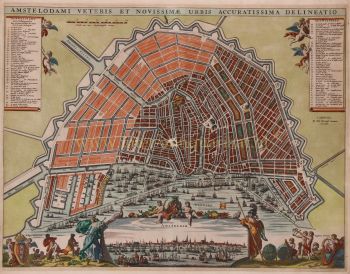
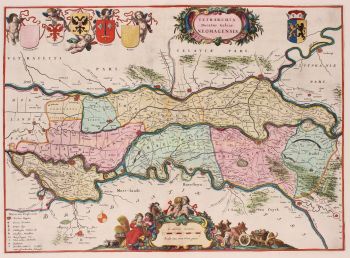
Antique map of Amsterdam, Amstel canal - Daniël Stoopendael + Widow Nicolaes Visscher, ca. 1720 by Artista Desconocido
Scroll to zoom, click for slideshow

Antique map of Amsterdam, Amstel canal - Daniël Stoopendael + Widow Nicolaes Visscher, ca. 1720 1720

Artista Desconocido

Impresión
57 ⨯ 94 cm
€ 4.250

Inter-Antiquariaat Mefferdt & De Jonge

  • Sobre la obra de arte
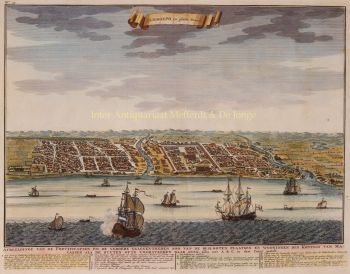
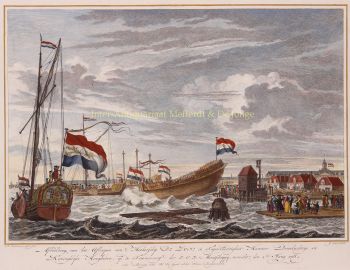
    BUSY 18TH CENTURY AMSTERDAM CANAL "Gezicht op de Binnen Amstel en Schut Sluys, ‘t Diaken Weeshuys nabij de Blauwe Brug vanaf de Amstelbrug gezien." [View of the inner Amstel river and lock, the orphanage near the Blauwbrug, seen from the Amstel Bridge." Etching with engraving printed from 2 copper plates, made by Daniël Stoopendael (1672-1726), published in Amsterdam by the Widow of Nicolaas Visscher around 1720. Coloured by a later hand. Size (plate):  approx. 57,8 x 94 cm. After the enlargement of the so called 'Grachtengordel' [today's canal district] with a fourth extention, a bridge was built over the Amstel in 1662, connecting the city walls on both sides of the river. The bridge had the same height as the ramparts, approx. six meters, and was therefore soon called 'Hogesluis' [high lock]. Here we see the Amstel river from this Hogesluis in a northerly direction to the Amstelsluizen, the Magere Brug (built in 1691) and the Blauwbrug. The Amstel locks were constructed to improve the water renewal of the tidal river Amstel and the so called 'Burgwallen'. This was to prevent the strongly increased pollution of the Amstel and the canals. Initially there were to be two locks, later this was changed to three: a large one in the middle and a smaller one on either side. At that time there was a sluice gate between the outer locks and the two Amstel quays. The wooden houses were used for the collection of municipal taxes. The brick house on the left was for the lock keeper. In the background, behind the Blauwbrug, we see the Diaconie Weeshuis (an orphanage), where the Stopera (town hall/opera building) is located today. On the right side of the Amstel (where there is a windmill), is the location of the Carré theater since 1887. This large print is from a series of 25 separately published cityscapes and provides a magnificent picture of life in Amsterdam at the beginning of the 18th century. Reference: Hollstein 11; auction R.W.P. de Vries 1925, lot no. 275; auction Leonhardt collection, Christie's 1989, lot no. 29. Price: Euro 4.250,-
  • Sobre el artista

    Puede suceder que un artista o creador sea desconocido.

    Algunas obras no deben determinarse por quién está hecho o por (un grupo de) artesanos. Algunos ejemplos son estatuas de la Antigüedad, muebles, espejos o firmas que no son claras o legibles, pero también algunas obras no están firmadas en absoluto.

    También puedes encontrar la siguiente descripción:

    •"Atribuido a …." En su opinión, probablemente una obra del artista, al menos en parte.

    •“Estudio de….” o “Taller de” En su opinión, una obra ejecutada en el estudio o taller del artista, posiblemente bajo su supervisión

    •“Círculo de…” En su opinión, una obra del período del artista que muestra su influencia, estrechamente asociado con el artista pero no necesariamente su alumno.

    •"Estilo de …." o “Seguidor de…”. En su opinión, una obra ejecutada al estilo del artista pero no necesariamente por un alumno; puede ser contemporáneo o casi contemporáneo

    •"Manera de …." En su opinión una obra al estilo del artista pero de fecha posterior

    •"Después …." En su opinión, una copia (de cualquier fecha) de una obra del artista

    •“Firmado…”, “Fechado…” o “Inscrito” En su opinión, la obra ha sido firmada/fechada/inscrita por el artista. La adición de un signo de interrogación indica un elemento de duda.

    •“Con firma…”, “Con fecha…”, “Con inscripción…” o “Lleva firma/fecha/inscripción” en su opinión la firma/fecha/inscripción ha sido añadida por alguien que no es el artista

¿Está interesado en comprar esta obra de arte?