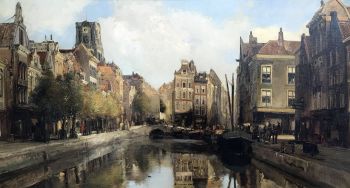
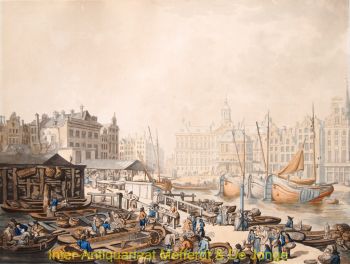
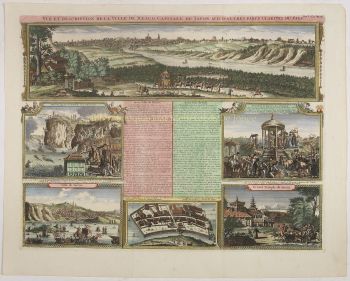
De Beurs en beursbrug te Rotterdam by Artista Desconocido
Scroll to zoom, click for slideshow

De Beurs en beursbrug te Rotterdam 1840

Artista Desconocido

53 ⨯ 65 cm
€ 1.250

Inter-Antiquariaat Mefferdt & De Jonge

  • Sobre la obra de arte
    “De Beurs en beursbrug te Rotterdam”, rare lithograph made around 1840 by Jacob Josephus van Rijckevorsel (1785-1862). Coloured by a later hand. Size: 53,5 x 65,6 cm. We see the Blaak (canal) with the Zuidblaak, the Beurs [exchange] and the Beursbrug [exchange bridge] (built in 1826 to replace the old double-beam drawbridge). The streets are not very busy. A merchant unloads his ship, part of his goods have been loaded onto a sled. He quarrels with a vegetable seller. More than ten years before the exhange of Hendrick de Keyser was built n Amsterdam - in 1598 to be precise - Rotterdam already had an exchange on the Haringvliet. There was mainly trade in goods. Lack of space meant that trade moved to the Noordblaak in 1635. From 1736, the trade took place in a new building building designed by architect Adriaen van der Werff on Westnieuwland, on the north bank of the Blaak. The square in front of the eastern entrance became the Beursplein. It was said that the Rotterdam exchange was the most beautiful in Holland, perhaps even the most beautiful in all of Europe. In 1867 the building was given a glass roof after the example of London's Crystal Palace. In 1877, the Rotterdam Beurs train station was opened across the Beursplein as part of the Luchtspoor Breda-Rotterdam railway line. The building was destroyed on 14 May 1940 during the bombing of Rotterdam. Price: Euro 1.250,-
  • Sobre el artista

    Puede suceder que un artista o creador sea desconocido.

    Algunas obras no deben determinarse por quién está hecho o por (un grupo de) artesanos. Algunos ejemplos son estatuas de la Antigüedad, muebles, espejos o firmas que no son claras o legibles, pero también algunas obras no están firmadas en absoluto.

    También puedes encontrar la siguiente descripción:

    •"Atribuido a …." En su opinión, probablemente una obra del artista, al menos en parte.

    •“Estudio de….” o “Taller de” En su opinión, una obra ejecutada en el estudio o taller del artista, posiblemente bajo su supervisión

    •“Círculo de…” En su opinión, una obra del período del artista que muestra su influencia, estrechamente asociado con el artista pero no necesariamente su alumno.

    •"Estilo de …." o “Seguidor de…”. En su opinión, una obra ejecutada al estilo del artista pero no necesariamente por un alumno; puede ser contemporáneo o casi contemporáneo

    •"Manera de …." En su opinión una obra al estilo del artista pero de fecha posterior

    •"Después …." En su opinión, una copia (de cualquier fecha) de una obra del artista

    •“Firmado…”, “Fechado…” o “Inscrito” En su opinión, la obra ha sido firmada/fechada/inscrita por el artista. La adición de un signo de interrogación indica un elemento de duda.

    •“Con firma…”, “Con fecha…”, “Con inscripción…” o “Lleva firma/fecha/inscripción” en su opinión la firma/fecha/inscripción ha sido añadida por alguien que no es el artista

¿Está interesado en comprar esta obra de arte?