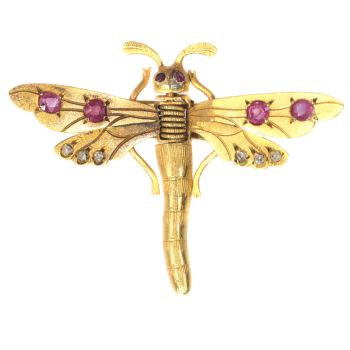
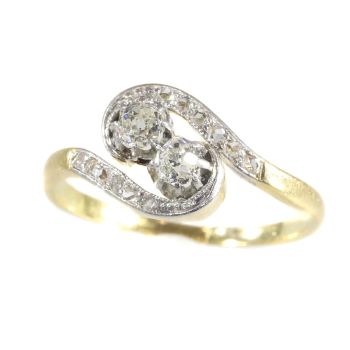
French Victorian Bar Brooch with Bejewelled Beetle in Garnet, Ruby and Diamonds by Artista Desconocido

French Victorian Bar Brooch with Bejewelled Beetle in Garnet, Ruby and Diamonds 1860

Artista Desconocido

DiamanteGranateRubíPiedra preciosa
€ 9.750

Adin Fine Antique Jewellery

  • Sobre la obra de arte

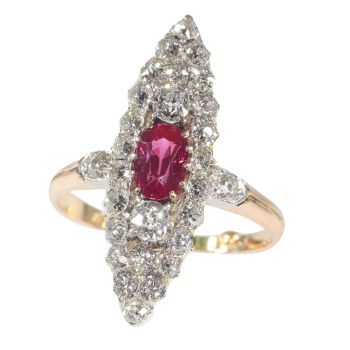
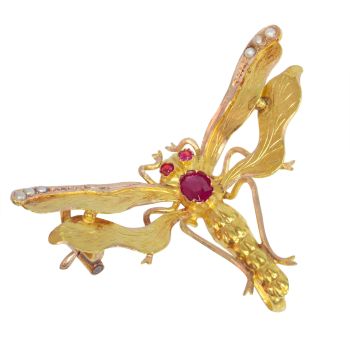
    French, circa 1860, a Victorian bar brooch in 18 carat warm yellow gold, centred by a jewelled beetle. The wing covers are formed by two domed garnets of deep wine colour, while the thorax is set with rose cut diamonds and tiny senailles in a silvertop. Ruby eyes give a sly, alert expression, and a single pearl finial softens the line of the bar. With the wing cases eased open, it feels less pinned than briefly persuaded to stay.

    Jewellery Type
    brooch

    Condition
    very good condition
    more info on our condition scale

    Country of origin
    France

    Style
    Victorian - Victorian decorative arts refers to the style of decorative arts during the Victorian era. The Victorian era is known for its eclectic revival and interpretation of historic styles and the introduction of cross-cultural influences from themiddle east and Asia in furniture, fittings, and Interior decoration. Victorian design is widely viewed as having indulged in a regrettable excess of ornament. The Arts and Crafts movement, the aesthetic movement, Anglo-Japanese style, and Art Nouveaustyle have their beginnings in the late Victorian era.
    See also: Victorian
    more info on styles

    Period
    ca. 1860
    Events & facts of this era, poetry of this era, fashion of this era.

    Source of inspiration
    Mother Nature

    Theme
    beetle

    Material 18K
    warm yellow gold (touchstone tested)
    more info on precious metals

    Diamonds
    Fourteen rose cut diamonds and senailles. A senaille is a simplified rose cut diamond, a small diamond chip with perhaps a few polished facets. We do not have the weight of the rose cuts diamonds nor the senailles which is normal in our trade when it comes to rose cut diamonds and senailles.

    - All diamonds, regardless of their size or shape, in our vintage and antique jewellery are verified as 100% natural by the IJGC laboratory.

    Precious stones
    Two garnet
    Two rubies. We did not check if the rubies are lab produced or not as this information has no influence on the value of this jewel. Natural rubies and lab produced rubies were both used in this era, rather more for their effect than for their intrinsic value.
    One pearl

    Birthstones
    Diamond is the birthstone (or month stone) for April, ruby for July garnet for January and pearl for June.
    more info on birthstones

    Hallmarks
    The French control mark for 18K gold representing an eagle's head that was in use in France from about 1838.
    more info on hallmarks

    Dimensions
    5,34 cm (2,10 inch) x 1,88 cm (0,74 inch)
    see picture with a ruler in millimeters and inches

    Weight
    8,20 gram (5,27 dwt)

    Adin Reference Nº
    26050-0148

    Copyright photography
    Adin, fine antique jewellery

    Additional information
    our latest acquisitions
    jewelry glossary
    wall of fame
    visit us in Antwerp
    subscribe to our mailinglist

  • Sobre el artista

    Puede suceder que un artista o creador sea desconocido.

    Algunas obras no deben determinarse por quién está hecho o por (un grupo de) artesanos. Algunos ejemplos son estatuas de la Antigüedad, muebles, espejos o firmas que no son claras o legibles, pero también algunas obras no están firmadas en absoluto.

    También puedes encontrar la siguiente descripción:

    •"Atribuido a …." En su opinión, probablemente una obra del artista, al menos en parte.

    •“Estudio de….” o “Taller de” En su opinión, una obra ejecutada en el estudio o taller del artista, posiblemente bajo su supervisión

    •“Círculo de…” En su opinión, una obra del período del artista que muestra su influencia, estrechamente asociado con el artista pero no necesariamente su alumno.

    •"Estilo de …." o “Seguidor de…”. En su opinión, una obra ejecutada al estilo del artista pero no necesariamente por un alumno; puede ser contemporáneo o casi contemporáneo

    •"Manera de …." En su opinión una obra al estilo del artista pero de fecha posterior

    •"Después …." En su opinión, una copia (de cualquier fecha) de una obra del artista

    •“Firmado…”, “Fechado…” o “Inscrito” En su opinión, la obra ha sido firmada/fechada/inscrita por el artista. La adición de un signo de interrogación indica un elemento de duda.

    •“Con firma…”, “Con fecha…”, “Con inscripción…” o “Lleva firma/fecha/inscripción” en su opinión la firma/fecha/inscripción ha sido añadida por alguien que no es el artista

¿Está interesado en comprar esta obra de arte?