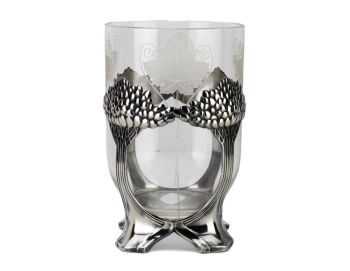
Johann Loetz Witwe – Phänomen Genre 8065 – Thea by Johann Loetz (Lötz) Witwe Klostermühle

Johann Loetz Witwe – Phänomen Genre 8065 – Thea 1899 - 1900

Johann Loetz (Lötz) Witwe Klostermühle

Vidrio
18 ⨯ 4 cm, ø 5 cm
ConditionExcellent
Precio a consultar

Antiques Emporium

  • Sobre la obra de arte
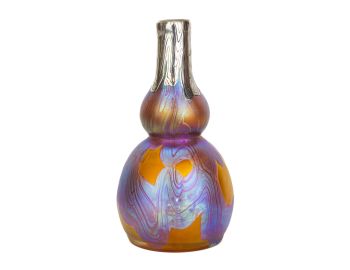
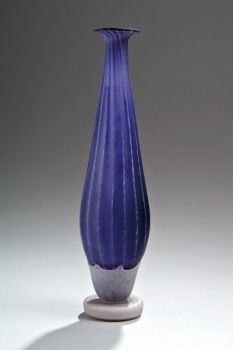
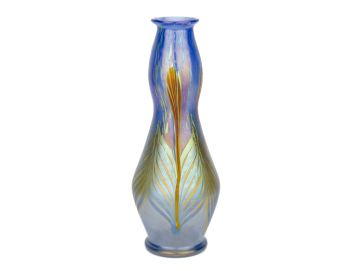
    This elegant Phänomen Genre 8065 Art Nouveau vase, crafted by Johann Loetz Witwe, was designed in 1899, just before the great success of the Paris Exposition Universelle in 1900. During this crucial period, Max Ritter von Spaun and Eduard Prochaska were fully engaged in refining innovative glass techniques and developing groundbreaking designs. Their goal was to elevate the iridescent glass, which they had been producing since 1898, to an even higher level and to firmly establish Loetz as a pioneer in the world of glass art.

    This vase is a stunning example of the artistic and technical innovations that Johann Loetz Witwe introduced around 1899. The combination of the subtle color, the intricate glass thread decoration, and the refined iridescence makes this piece an exceptionally rare and highly sought-after object in the world of Art Nouveau glass art.

    Johann Loetz Witwe – Phänomen Genre 8065 – Thea
    This vase is blown in the subtle and refined base color “Thea,” a soft hue that beautifully enhances the iridescence and decoration. The execution belongs to the rare Phänomen Genre 8065, which debuted in 1899. Remarkably, this is one of the few Phänomen Genre decorations produced under the same production number, 8065, further emphasizing the exclusivity of this decor.

    The surface of the vase is adorned with a dense pattern of silver-blue glass threads that gracefully swirl across the body. The upper section is further enriched with applied silver-blue bands, which are pulled downward into elegant, elongated droplet shapes. This delicate and highly refined decoration creates a dynamic and flowing effect, characteristic of the innovative aesthetics of Loetz glass art at the turn of the century.

    The combination of the subtle base color “Thea,” the intricate glass thread decoration, and the refined iridescence makes this piece an exceptionally rare and highly sought-after object in the world of Art Nouveau glass art. The decorative technique, where silver-yellow glass threads elegantly weave across the surface and extend into elongated droplet shapes, reflects the innovative spirit of Loetz during this period.

    Signature
    The vase is in excellent condition and is signed with a wheel-engraved “Loetz Austria” mark. This signature was first introduced just before the turn of the century, during a period when Loetz began systematically marking their works for the international market. As Loetz gained increasing global recognition, a more distinctive signature became necessary, since the earlier marking with Max Ritter von Spaun’s family crest was not directly associated with the glassworks.

    Additionally, the original spelling “Lötz” with an umlaut proved confusing for languages that do not use this diacritical mark. To avoid misunderstandings and enhance brand recognition, the standardized signature “Loetz Austria” was introduced, specifically intended for export markets.
  • Sobre el artista

    La cristalería Loetz existió en Klostermuhle, Austria, durante poco más de cien años, a partir de 1840. Pero su apogeo fue durante la vida de Max Ritter Von Spaun, nieto del Johann Loetz original que había fundado la empresa.

    Von Spaun se hizo cargo de la empresa en 1879 y la dirigió hasta 1908, un año antes de su muerte. Fue asistido por Eduard Prochaska, su especialista técnico, y juntos inventaron, diseñaron y produjeron toda una serie de maravillosos nuevos tipos de vidrio, obteniendo varias patentes y ganando premios en todas las principales exposiciones mundiales durante la década de 1890 y los primeros años de el nuevo siglo.

    La empresa Loetz se encontraba entre los líderes en diseño Art Nouveau y especialmente en vidrio artístico iridiscente. El vidrio "Papillon", como el jarrón de la izquierda, a veces se conoce hoy como vidrio "mancha de aceite". Otro colorante favorito de Loetz fue el vidrio irridizado con senderos tirados llamado vidrio "Fenómeno".

    Había jarrones irridizados con cintas de colores metálicos que serpenteaban sobre la superficie, y muchos diseños espectaculares con estelas aplicadas de hermosos colores, o simplemente sacadas del cuerpo del vidrio para formar asas o decoración.

    Alrededor de 1900, la compañía comenzó a colaborar con diseñadores externos, y algunos grandes artistas diseñaron piezas para Lotz, en particular Joseph Hofmann, Koloman Moser, Maria Kirchner y Hofstatter.

    En 1908 Loetz fue adquirido por el hijo de Max Von Spaun, también llamado Max, y aunque luchó financieramente (pasando por la quiebra en 1911 y nuevamente en 1931) hubo varios grandes diseñadores cuyo trabajo fue producido por Loetz durante esos años y a través del arte. período de deco. Estos incluyeron a Adolf Beckert y Michael Powolny.

¿Está interesado en comprar esta obra de arte?