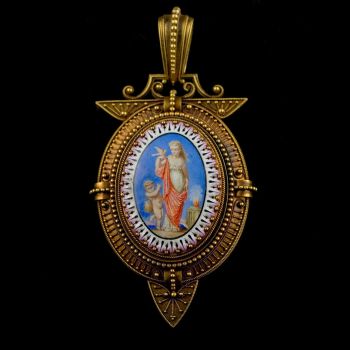
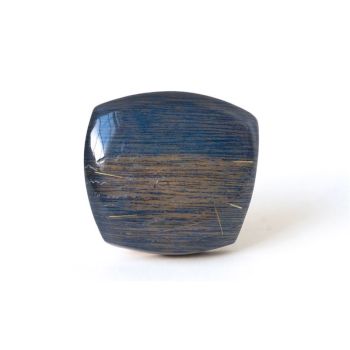
An unusually large French brooch dating to circa 1830, showcasing a finely carved male portrait in brown chalcedony, mounted atop a subtly faceted pale agate or quartz base. The jewel’s generous proportions, combined with intricate canetille goldworkand vibrant blue enamel, create a striking neoclassical presence. Likely once the centrepiece of a grander jewel, it was later adapted into a brooch with remarkable finesse. A rare survivor of refined early 19th-century taste — imposing yet intimate, and quietly evocative.
Antique jewelry object group
brooch
Condition
very good condition
more info on our condition scale
Country of origin
Although it does not carry any legible control marks we believe this to be of French origin.
Style
Early 19th Century
more info on styles
Style specifics
This jewel reflects the neoclassical aesthetic so popular during the post-Napoleonic era, combining refined goldwork in cannetille technique with a classically inspired profile portrait. Though now functioning as a brooch, the slight curvature andconstruction details suggest it originally served as the central element of a bracelet or necklace. Its composition and technique would not be out of place in a 19th-century collection.
Period
ca. 1830
Events & facts of this era, poetry of this era, fashion of this era.
Source of inspiration
The classicism of Ancient Rome, as revived in the late 18th and early 19th centuries, clearly served as inspiration. The male portrait evokes the idealised profiles of Roman emperors or philosophers, often used in jewellery as symbols of virtue,intellect, and legacy.
Theme
Portraiture in jewellery – commemoration or idealisation of the masculine figure. Whether representing a known person or a symbolic model of masculine virtue, this piece fits within a wider tradition of wearable neoclassical imagery.
Material 18K
yellow gold (touchstone tested)
more info on precious metals
Historical adaptation
Although now functioning as a brooch, the jewel's slight curvature and construction strongly suggest it originally formed the central element of a modular bracelet or necklace — possibly a collier de chien or collier à plaque, popular around 1830. Thebrooch fitting is not original, but was expertly added using existing structural components: two hollow, tube-shaped elements at the back, likely part of the original framework. These tubes were carefully opened along their length to insert the hinge onone side and the catch on the other, before being neatly closed again. The absence of stress marks or distortion indicates that this conversion was executed with considerable skill, most likely already in the 19th or early 20th century.
Technique
Cameo is a method of carving, or an item of jewellery or vessel made in this manner. It features a raised (positive) relief image. There are three main materials for Cameo carving; Shells or Agate (called a Hardstone cameo), and glass. Cameos can beproduced by setting a carved relief, such as a portrait, onto a background of a contrasting colour. This is called an assembled cameo. Alternately, a cameo can be carved directly out of a material with integral layers or banding, such as (banded) agateor layered glass, where different layers have different colours. Sometimes dyes are used to enhance these colours. Cameos are often worn as jewellery. Stone cameos of great artistry were made in Greece dating back as far as the 6th century BC. They werevery popular in Ancient Rome, and one of the most famous stone cameos from this period is the Gemma Claudia made for the Emperor Claudius. The technique has since enjoyed periodic revivals, notably in the early Renaissance, and again in the 17th, 18thand 19th centuries.
Enamelling is an old and widely-adopted technology. The ancient Egyptians applied enamels to pottery and stone objects. The ancient Greeks, Celts, Russians, and Chinese also used enameling processes on metal objects. Enamel is the colorful result offusing powdered glass to a substrate by firing, usually between 750 and 850 degrees Celsius. The powder melts and flows and hardens to a smooth, durable vitreous coating on metal, glass or ceramic. According to some sources, the word enamel comes fromthe High German word smelzan (to smelt) via the Old French esmail. Used as a noun, "an enamel" is a usually small decorative object, coated with enamel coating, such as a champlevé or a cloisonné (different techniques).
This jewel features a filigree decoration, which is in fact thin gold wire twisted into refined motifs, in this case elegant little balls. You can also notice the use of granulation on this piece. Granulation is a technique where the goldsmith uses very small balls (granules) of metal, which are not soldered to the piece but welded. Both techniques demand very high skills and precision from the maker.
Precious stones
This jewel does not contain traditionally defined faceted gemstones. However, it features a finely carved male portrait in translucent brown chalcedony, most likely sarder, with scattered dark inclusions. The portrait is mounted onto a subtly faceted,lightly translucent backing stone of pale beige-grey tone — likely a variety of colourless agate or quartz — suggesting it was affixed rather than carved from a single block. The realism of the carving and the elegant mounting reflect the refinedneoclassical taste of the early 19th century.
Birthstones
None applicable.
more info on birthstones
Hallmarks
No trace.
more info on hallmarks
Dimensions
9,00 cm (3,54 inch) x 6,86 cm (2,70 inch)
see picture with a ruler in millimeters and inches
Weight
26,90 gram (17,30 dwt)
Adin Reference Nº
25104-0158
Copyright photography
Adin, fine antique jewellery
Additional information
our latest acquisitions
jewelry glossary
wall of fame
visit us in Antwerp
subscribe to our mailinglist