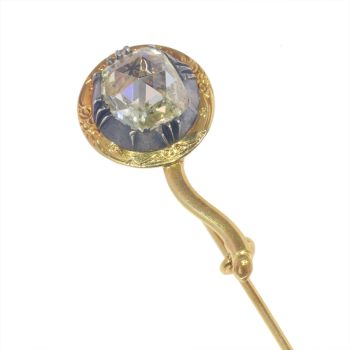
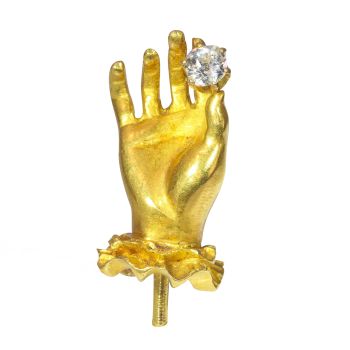
This early Victorian stickpin from around 1850 shows a delicately modelled hand in matte yellow gold, lifting a rose cut diamond with graceful precision. The sculpted cuff, with its scalloped edging and gentle folds, adds a charming touch of periodfashion, as if capturing a gesture from a romantic miniature portrait. Its blend of sentiment, artistry and tactile detail makes this a refined keepsake from the Romantic Victorian era.
Jewellery Type
tie pin or stick pin
Condition
very good condition
more info on our condition scale
Country of origin
unknown
Style
Victorian - Victorian decorative arts refers to the style of decorative arts during the Victorian era. The Victorian era is known for its eclectic revival and interpretation of historic styles and the introduction of cross-cultural influences from themiddle east and Asia in furniture, fittings, and Interior decoration. Victorian design is widely viewed as having indulged in a regrettable excess of ornament. The Arts and Crafts movement, the aesthetic movement, Anglo-Japanese style, and Art Nouveaustyle have their beginnings in the late Victorian era.
See also: Victorian
more info on styles
Style specifics
The Romantic Victorian Period - Experts divide the reign of Queen Victoria, also called The Victorian era (1837 - 1901) in to three periods of about twenty years each; The Romantic Victorian Period (1837 - 1860), The Grand Victorian Period (1860 -1880), and the Late or Aesthetic Victorian Period (1880 - 1901).
We consider this to be of the Romantic Victorian Period. This period covers the coronation of Victoria as Queen of Great Britain and Ireland, and her marriage to King Albert and their love, their devotion to their marriage and to their country are thesources of inspiration for this period. The jewels of this period are made of intricate carvings, special techniques where the enamel is subtly worked. These techniques allowed to give the jewel a certain opulence with less precious metal needed. Asprecious metals were really rare at that time. Highly favored (semi-) precious stones in this period are amethyst, coral, garnets, seed pearls and turquoises. The connotation is obviously sentimental, symbolic and romantic with reminiscent Gothic and/orRenaissance patterns and an abundant use of motifs like anchors, birds, branches, crosses, hearts and snakes.
Period
ca. 1850
Events & facts of this era, poetry of this era, fashion of this era.
Theme
hand holding a diamond between its fingers
Material18K
yellow gold (touchstone tested)
more info on precious metals
Technique
The rose cuts are set on foil. This is a special technique that was used to bring the lustre of the diamonds to its best quality.
Diamonds
One rose cut diamond. We do not have the weight of this diamond which is normal in our trade when it comes to rose cuts.
- All diamonds, regardless of their size or shape, in our vintage and antique jewellery are verified as 100% natural by the IJGC laboratory.
- We do not sell lab-grown (synthetic) diamonds.
Birthstones
Diamond is the birthstone (or month stone) for April.
more info on birthstones
Hallmarks
No trace.
more info on hallmarks
Dimensions
hand 2,10 cm (0,83 inch) x 0,85 cm (0,33 inch), total length 9,60 cm (3,78 inch)
see picture with a ruler in millimeters and inches
Weight
4,30 gram (2,76 dwt)
Adin Reference Nº
25321-0203
Copyright photography
Adin, fine antique jewellery
Additional information
our latest acquisitions
jewelry glossary
wall of fame
visit us in Antwerp
subscribe to our mailinglist