VIEW OF 17TH CENTURY AMSTERDAM  by Caspar Merian
Scroll to zoom, click for slideshow

VIEW OF 17TH CENTURY AMSTERDAM  1650

Caspar Merian

PapelImpresión
19 ⨯ 70 cm
€ 1.250

Inter-Antiquariaat Mefferdt & De Jonge

  • Sobre la obra de arte
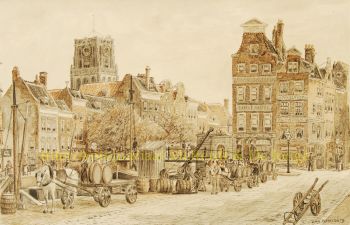
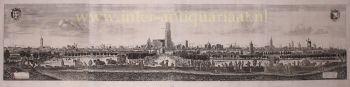
    VIEW OF 17TH CENTURY AMSTERDAM  "Amsterdam", engraving printed from two copperplates, made around 1650, published in Frankfurt am Main by Caspar Merian in 1659. Coloured by a later hand. Size: 19.5 × 70.5 cm. From the Topographia Germaniae Inferioris. From left to right one can distinguish the Rijzenhoofd, the Antoniespoort, the West India warehouse, the Montelsbaanstoren, Zuiderkerk tower, Munttoren, and Schreierstoren, the Walloon Church, Sint-Olofskapel,(Chapel of St. Olaf), the Old Church, the Nieuwezijds Kapel, the stock exchange, the Waag, the old Town Hall with its pointed tower, the Nieuwe Kerk with its completed tower, the Jan Rodenpoort tower, Haringpakkers tower, and Wester tower, the Noorderkerk, the Bickers tower, and the Haarlemmerpoort. The city’s grain warehouses are also depicted; the old Town Hall had not yet burned down (1652). Topographia Germaniae Inferioris was part of the Topographia Germaniae, the most important work of engraver and publisher Matthäus Merian the Elder (1593–1650). He published this monumental work together with Martin Zeiler (1589–1661) of Ulm, who was responsible for the text. The work contains around 2,000 illustrations and plans of towns, monasteries, and castles and is considered one of the most significant achievements in the field of topographical illustration. Merian had begun in 1642 with the publication of a survey of town views, landscapes, and maps, for which he had been collecting drawings for decades. Up to 1688 the series was expanded with further descriptions of European regions, ultimately reaching 30 volumes with a total of 92 maps and 2,142 town views, making it one of the largest publications of its time. The first volumes were engraved and published by Matthäus Merian himself. Later, much of the engraving work was commissioned from several prominent engravers of the day, while his sons Matthäus the Younger and Caspar took over the publishing activities. Price: Euro 1.250,-
  • Sobre el artista

    Caspar Merian (1627-1686) fue un destacado grabador topográfico, cartógrafo y editor suizo-alemán que desempeñó un papel fundamental en la continuidad de una de las dinastías editoriales más influyentes del siglo XVII. Nacido en el seno de la renombrada familia Merian, era hijo de Matthäus Merian el Viejo, cuyo taller en Fráncfort se había convertido en un centro líder de libros ilustrados y mapas en Europa.Caspar Merian (1627-1686) fue un destacado grabador topográfico, cartógrafo y editor suizo-alemán que desempeñó un papel fundamental en la continuidad de una de las dinastías editoriales más influyentes del siglo XVII. Nacido en el seno de la renombrada familia Merian, era hijo de Matthäus Merian el Viejo, cuyo taller en Fráncfort se había convertido en un centro líder de libros ilustrados y mapas en Europa.

    Junto con su hermano, Matthäus Merian el Joven, Caspar se hizo cargo de la editorial familiar en Fráncfort y consolidó su reputación por la alta calidad de sus obras topográficas e históricas. Sus publicaciones combinaban una precisión geográfica minuciosa con una rica narrativa visual, contribuyendo significativamente a la difusión del conocimiento sobre las regiones y ciudades europeas.

    Entre sus obras más importantes se encuentran los volúmenes de la serie Topographia, incluyendo Topographia Germaniae Inferioris vel Circuli Burgundici, que ofrecía descripciones detalladas y grabados de las principales ciudades y regiones de las Diecisiete Provincias (los Países Bajos). También contribuyeron a la continuación del monumental Theatrum Europaeum, una extensa crónica de los acontecimientos políticos y militares europeos.

    Más adelante, debido a problemas de salud, Caspar Merian se trasladó de Fráncfort a Wertheim en 1672, y posteriormente a Frisia en 1677, donde se unió a la comunidad religiosa labadista. A pesar de estos cambios posteriores, su obra siguió siendo profundamente influyente. Mediante sus grabados y publicaciones, Caspar Merian contribuyó a dar forma a la cartografía y la representación topográfica europeas de la Edad Moderna, preservando y ampliando el legado de la editorial Merian.

¿Está interesado en comprar esta obra de arte?

Artwork details