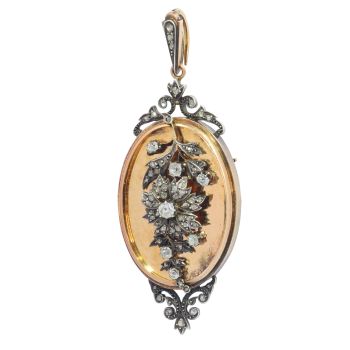
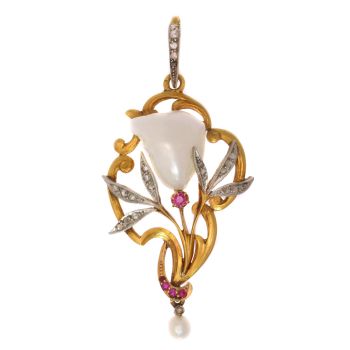
A marvel of Victorian artistry, this grand brooch captivates with its blend of natural inspiration and exquisite craftsmanship. At its heart lies an extraordinary blister pearl, almost 40mm in length, with intricate lines and grooves that evoke thepetals of a flower in bloom. This rare pearl is set amid vibrant green enamel leaves, their texture reminiscent of delicate veining, adding lifelike depth to the design. Surrounding the pearl, 49 old brilliant-cut diamonds, totalling approximately 4.80carats, glisten with subtle fire, enhancing the piece’s aura of mystery. Each element reflects the Romantic Victorian Period's reverence for nature and sentimentality, while the baroque pearl nestled alongside furthers its organic elegance. Likelycrafted during the Second Empire period, circa 1840, this brooch is a unique treasure from a bygone age, exuding an air of exclusivity that few pieces can rival.
Antique jewelry object group brooch/pin
Condition In very good condition, though there are slight imperfections on the enamel surface, and the back clearly shows signs of work done over the long life of this jewel. It’s even possible that, despite its substantial size, this piece was once part of aneven more impressive jewel. more info on our condition scale
Country of origin unknown
Style Victorian - Victorian decorative arts refers to the style of decorative arts during the Victorian era. The Victorian era is known for its eclectic revival and interpretation of historic styles and the introduction of cross-cultural influences from themiddle east and Asia in furniture, fittings, and Interior decoration. Victorian design is widely viewed as having indulged in a regrettable excess of ornament. The Arts and Crafts movement, the aesthetic movement, Anglo-Japanese style, and Art Nouveaustyle have their beginnings in the late Victorian era. See also: Victorian more info on styles
Style specifics The Romantic Victorian Period - Experts divide the reign of Queen Victoria, also called The Victorian era (1837 - 1901) in to three periods of about twenty years each; The Romantic Victorian Period (1837 - 1860), The Grand Victorian Period (1860 -1880), and the Late or Aesthetic Victorian Period (1880 - 1901).
We consider this to be of the Romantic Victorian Period. This period covers the coronation of Victoria as Queen of Great Britain and Ireland, and her marriage to King Albert and their love, their devotion to their marriage and to their country are thesources of inspiration for this period. The jewels of this period are made of intricate carvings, special techniques where the enamel is subtly worked. These techniques allowed to give the jewel a certain opulence with less precious metal needed. Asprecious metals were really rare at that time. Highly favored (semi-) precious stones in this period are amethyst, coral, garnets, seed pearls and turquoises. The connotation is obviously sentimental, symbolic and romantic with reminiscent Gothic and/orRenaissance patterns and an abundant use of motifs like anchors, birds, branches, crosses, hearts and snakes.
Period Although we found no direct reference material in our extensive library, and despite the diamonds in this jewel appearing to be distinctly 18th-century in character, we believe that the style of this piece aligns with theso-called Second Empire, likely Spanish or French, circa 1840. Events & facts of this era, poetry of this era, fashion of this era.
Source of inspiration Mother Nature
Theme blooming flower
Material 18K yellow gold (touchstone tested) more info on precious metals
Technique Enamelling is an old and widely-adopted technology. The ancient Egyptians applied enamels to pottery and stone objects. The ancient Greeks, Celts, Russians, and Chinese also used enameling processes on metal objects. Enamel is the colorful result offusing powdered glass to a substrate by firing, usually between 750 and 850 degrees Celsius. The powder melts and flows and hardens to a smooth, durable vitreous coating on metal, glass or ceramic. According to some sources, the word enamel comes fromthe High German word smelzan (to smelt) via the Old French esmail. Used as a noun, "an enamel" is a usually small decorative object, coated with enamel coating, such as a champlevé or a cloisonné (different techniques).
Extra information This is our first time encountering such a striking blister pearl, one that leaves everyone in awe upon first sight. Holding it is a genuine ‘wow’ moment. Its size—close to 40mm in length—and the intricate lines and grooves on the top surface make this a piece that’s not easily forgotten.
Diamonds 49 old brilliant cut diamondswith an estimated weight of ± 4.80ct colour and clarity F/J, vs/i
- When we provide weights, colour grades, and clarity of diamonds, these are approximate unless otherwise stated, as we do not remove diamonds from their settings to preserve the integrity of the piece.
- All diamonds, regardless of their size or shape, in our vintage and antique jewellery are verified as 100% natural by the IJGC laboratory.
- We do not sell lab-grown (synthetic) diamonds.
Precious stones One large blister pearl and one baroque pearl
Birthstones Diamond is the birthstone (or month stone) for April and pearl for June. more info on birthstones
Hallmarks No trace. more info on hallmarks
Dimensions 7,10 cm (2,80 inch) x 7,00 cm (2,76 inch) see picture with a ruler in millimeters and inches
Weight 68,50 gram (44,05 dwt)
Adin Reference Nº 24298-0149
Copyright photography Adin, fine antique jewellery
Additional information our latest acquisitions jewelry glossary wall of fame visit us in Antwerp subscribe to our mailinglist
Puede suceder que un artista o creador sea desconocido.
Algunas obras no deben determinarse por quién está hecho o por (un grupo de) artesanos. Algunos ejemplos son estatuas de la Antigüedad, muebles, espejos o firmas que no son claras o legibles, pero también algunas obras no están firmadas en absoluto.
También puedes encontrar la siguiente descripción:
•"Atribuido a …." En su opinión, probablemente una obra del artista, al menos en parte.
•“Estudio de….” o “Taller de” En su opinión, una obra ejecutada en el estudio o taller del artista, posiblemente bajo su supervisión
•“Círculo de…” En su opinión, una obra del período del artista que muestra su influencia, estrechamente asociado con el artista pero no necesariamente su alumno.
•"Estilo de …." o “Seguidor de…”. En su opinión, una obra ejecutada al estilo del artista pero no necesariamente por un alumno; puede ser contemporáneo o casi contemporáneo
•"Manera de …." En su opinión una obra al estilo del artista pero de fecha posterior
•"Después …." En su opinión, una copia (de cualquier fecha) de una obra del artista
•“Firmado…”, “Fechado…” o “Inscrito” En su opinión, la obra ha sido firmada/fechada/inscrita por el artista. La adición de un signo de interrogación indica un elemento de duda.
•“Con firma…”, “Con fecha…”, “Con inscripción…” o “Lleva firma/fecha/inscripción” en su opinión la firma/fecha/inscripción ha sido añadida por alguien que no es el artista