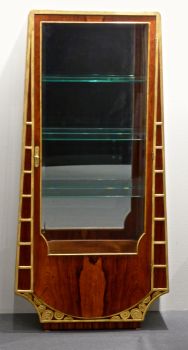
A very rare Brazilian Rosewood veneered cabinet on slender legs. Designed by the Danish designer and architect Ole Wanscher in 1954 and executed by the esteemed cabinetmaker A.J. Iversen of Copenhagen.
Raised on slender legs and veneered in richly figured Brazilian rosewood, it features a clear, well-balanced structure with hinged doors opening to adjustable interior shelves. Below the cabinet body are two extendable pull-out shelves, adding practical surface space. Subtle brass fittings, including hinges and handles, provide a restrained contrast to the warm wood. The piece reflects Wanscher’s calm, architectural approach and Iversen’s refined craftsmanship.
About Ole Wanscher
Ole Wanscher (Frederiksberg, Denmark 1903 – Charlottenlund, Denmark 1985) was a Danish architect and furniture designer whose work represents a restrained and scholarly strand of Scandinavian modernism. Known for his calm proportions and deep respect for historical furniture traditions, Wanscher developed a design language that balanced modern clarity with classical order.
Wanscher was trained as an architect at the Royal Danish Academy of Fine Arts in Copenhagen, where he studied under Kaare Klint, a central figure in the development of modern Danish furniture design. Klint’s emphasis on careful measurement, functional analysis, and historical study had a lasting influence on Wanscher’s approach. From early on, Wanscher demonstrated a particular interest in classical furniture forms, which he studied extensively and later documented in his writings.
Unlike many of his contemporaries, Wanscher did not seek to radically reinvent furniture design. Instead, he worked through refinement and adaptation, distilling historical models into simpler, more contemporary forms. His furniture is characterized by balanced proportions, clear construction, and a quiet elegance. Materials such as wood, cane, leather, and natural textiles are used with restraint, allowing structure and craftsmanship to take precedence over visual effect.
Wanscher collaborated with several Danish manufacturers, including A.J. Iversen and Fritz Hansen, producing furniture that was both well-crafted and practical. Chairs such as the Colonial Chair, the Egyptian Chair, and the Senator series are among his best-known designs. These pieces reflect his interest in historical references—ranging from English and French furniture to ancient Egyptian seating—interpreted through a modern, functional lens.
In addition to his design practice, Wanscher was an important theorist and educator. He taught at the Royal Danish Academy of Fine Arts, where he later succeeded Kaare Klint as professor. His academic work focused on furniture history and typology, and his publications contributed significantly to the understanding of furniture as a cultural and architectural discipline. This scholarly perspective informed his own designs, which often appear measured and deliberate rather than expressive.
Wanscher’s work never aimed for visual novelty or bold statements. Instead, it sought longevity and clarity, qualities that align closely with his belief that good furniture should endure both physically and aesthetically. His designs are often described as timeless, not because they avoid character, but because they rely on proportion, structure, and tradition rather than fashion.
Today, Ole Wanscher is regarded as a key figure in Danish design history. While his work is quieter and more conservative than that of some of his peers, it remains influential for its intellectual rigor and respect for craft. His furniture continues to be produced and collected, valued for its calm presence and enduring sense of balance.
Execution
A.J. Iversen, Denmark
Literature
Grete Jalk (ed.), Dansk Møbelkunst gennem 40 år, volume 3. (1947-1956) p.286 (illustrated)
Condition
This cabinet is in very good vintage condition. Paper label has been lost (was attached underneath and place where it was attached is still visible).
Dimensions
Height 154 cm
Width 112 cm
Depth 40 cm
Cites
A Cites permit within the European Union is included.