Compositie 1967 1967
Willem Hussem
Óleo sobre lienzo original
110 ⨯ 65 cm
Precio a consultar
Bruning Heintz Fine Art
- Sobre la obra de arteGedateerd: 1967
Grootte: 110 x 65 cm
Signatuur: Rechtsonder. In verso genummerd H4 317 (bekend in het archief van Dürst Britt & Mayhew)
Materiaal: Olieverf op jute
Stroming: Nieuwe Haagse School
Provenance: Particuliere collectie, voorheen galerie Erik Paol, daarvoor galerie Nouvelles Images
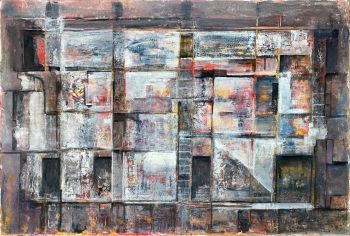
Het schilderij uit 1967 van Willem Hussem ontvouwt zich als een stille, doordachte compositie waarin eenvoud en beweging elkaar ontmoeten. Tegen een warme, zalmroze achtergrond schuiven grote, afgeronde vormen het beeld binnen, alsof ze net buiten het doek hun oorsprong hebben. Een brede, witte baan slingert zich door het midden, kruist zichzelf en verbindt de verschillende vlakken met een vanzelfsprekende rust. Het wit is niet strak of klinisch, maar levendig en tastbaar; je ziet hoe de verf is aangebracht, hoe de hand van de kunstenaar nog aanwezig is in elke streek. Aan de randen verschijnen diepe kleurvelden, d.w.z. een intens rood dat overgaat in zwart linksonder, een helder blauw met een donker accent rechtsboven, en een donker, bijna aards vlak linksboven. Deze vormen lijken afgesneden, als fragmenten van een groter geheel dat zich buiten het kader voortzet. Juist daardoor krijgt het schilderij een zekere spanning: het is tegelijk begrensd en open, ingetogen en dynamisch. Wat het werk bijzonder maakt, is de balans die Hussem weet te vinden. De ronde vormen verzachten, terwijl de witte banen richting geven en structuur aanbrengen. Alles lijkt op zijn plaats, zonder dat het statisch wordt. Het schilderij ademt een kalme ritmiek, een soort visuele muziek waarin elke vorm en kleur precies op het juiste moment klinkt. De originele aluminium lijst omlijst het geheel op subtiele wijze. Het koele, sobere materiaal contrasteert mooi met de warme kleuren en de zichtbare penseelstreken, zonder de aandacht op te eisen. Integendeel, de lijst versterkt de helderheid van de compositie en geeft het werk een tijdloze, bijna architectonische uitstraling. Dit past goed bij de abstracte vormentaal van de jaren zestig. Zo vormt het schilderij, samen met zijn aluminium lijst, een harmonieus geheel: ingetogen, maar krachtig; eenvoudig, maar rijk aan nuance. Een werk dat niet schreeuwt om aandacht, maar die stil en overtuigend vasthoudt.
Willem Hussem’s 1967 painting unfolds as a quiet, thoughtful composition in which simplicity and movement meet. Against a warm, salmon-pink background, large, rounded forms slide into the image, as if they originate just outside the canvas. A broad, white band winds through the center, crosses itself, and connects the various planes with a self-evident calm. The white is not stark or clinical, but lively and tangible; you can see how the paint has been applied, how the artist’s hand is still present in every stroke. Deep fields of color appear at the edges: an intense red transitioning into black in the lower left, a bright blue with a dark accent in the upper right, and a dark, almost earthy plane in the upper left. These forms appear cut off, like fragments of a larger whole that continues beyond the frame. It is precisely this that gives the painting a certain tension: it is simultaneously bounded and open, restrained and dynamic. What makes the work special is the balance Hussem manages to strike. The round forms soften, while the white stripes provide direction and add structure. Everything seems to be in place without becoming static. The painting exudes a calm rhythm, a kind of visual music in which every form and color strikes at precisely the right moment. The original aluminum frame subtly frames the whole. The cool, austere material contrasts beautifully with the warm colors and visible brushstrokes, without demanding attention. On the contrary, the frame enhances the clarity of the composition and gives the work a timeless, almost architectural appearance. This fits well with the abstract visual language of the sixties. Thus, the painting, together with its aluminum frame, forms a harmonious whole: restrained yet powerful; simple yet rich in nuance. A work that does not scream for attention, but holds it quietly and convincingly. - Sobre el artista
Willem Frans Karel Hussem (nacido en Rotterdam el 29 de enero de 1900, fallecido en La Haya el 21 de julio de 1974) fue un polifacético artista holandés, conocido como pintor, escultor y poeta.
Hussem recibió su formación de Dirk Nijland y tomó lecciones en la Academia de Rotterdam. Entre 1918 y 1936 permaneció en París, donde estableció contactos con destacados artistas como Piet Mondriaan y Pablo Picasso. En su estilo se nota claramente la influencia de Picasso y Vincent van Gogh.
En 1936, Hussem finalmente eligió La Haya como su base de operaciones, donde se instaló en Mijtensstraat en Schilderswijk. Después de la Segunda Guerra Mundial su arte evolucionó hacia la abstracción. Participó activamente en movimientos artísticos como Fugare, la Liga Nieuw Beelden y Verve, y su trabajo está asociado con la Escuela de Nueva Haya.
A pesar de su reconocimiento nacional e internacional, incluido el premio Jacob Maris en tres ocasiones (1952 y 1955 de pintura, 1958 de dibujo) y una invitación a la Bienal de Venecia, su familia vivía en circunstancias modestas.
Sus obras de arte forman parte de las colecciones de: Kunstmuseum The Hague, Stedelijk Museum Amsterdam, Dordrechts Museum y el Rijksmuseum Twenthe en Enschede.
El Posthoorngroep se formó alrededor de Hussem, un colectivo de artistas involucrados en la pintura, la poesía o ambas. Este grupo lleva el nombre de un conocido establecimiento de restauración de La Haya.
Como poeta e ilustrador, Hussem debutó en 1940 con "The Coastline", publicado por L.J.C. Boucher, seguido de "Sea View" en A.A.M. Stols en 1941. También ilustró con un bolígrafo dibujos de árboles en "Een lied van Isoude" de P.C. Boutens (1941). En la década de 1960 publicó varias colecciones de poesía, entre ellas la conocida "Voor twee dacharren bluebekken" (1966). Su poesía, a menudo enriquecida con sus propias ilustraciones, siguió apareciendo después de su muerte, siendo la última "Di con tinta" (2011). Hussem mantuvo una amistad con Simon Carmiggelt.
A partir de 1967, Hussem empezó a crear esculturas de metal.
Un trágico incidente afectó a una obra de arte en aluminio de Hussem, valorada en unos 100.000 euros, que fue destruida accidentalmente en 2017 durante la demolición de una oficina de correos en Raalte. La obra de arte fue uno de los últimos objetos destruidos en una trituradora, porque el promotor del proyecto no había sido informado de su valor cultural.

¿Está interesado en comprar esta obra de arte?
Artwork details
Related artworks
- 1 - 3 / 3
- 1 - 4 / 24
Julien T´ Felt
Still Life, copper kettle, jar and potatoes1922
Precio a consultarVan der Aalst Fine Art
Bernardus Johannes Blommers
SPELENDE VISSERSKINDEREN1845 - 1914
Precio a consultarGalerie Het Noorderlicht
1 - 4 / 24- 1 - 4 / 24
- 1 - 4 / 12