Johann Loetz Witwe – Phänomen Genre 1/18 vase by Johann Loetz (Lötz) Witwe Klostermühle

Johann Loetz Witwe – Phänomen Genre 1/18 vase 1901 - 1905

Johann Loetz (Lötz) Witwe Klostermühle

Vidrio
25 cm, ø 13 cm
ConditionExcellent
Precio a consultar

Antiques Emporium

  • Sobre la obra de arte
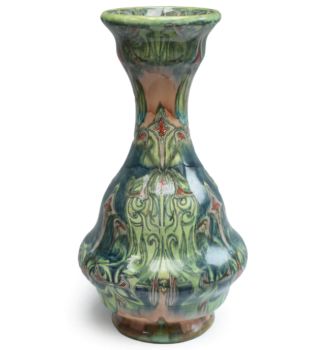
    This impressive Jugendstil vase was created by the renowned glassworks Johann Loetz Witwe, located in Klostermühle (present-day Czech Republic). Around 1900, Loetz gained international acclaim for its innovative and artistically sophisticated iridescent glass objects, many of which were presented at world exhibitions such as the Exposition Universelle in Paris in 1900. The company was led by Max Ritter von Spaun, with Eduard Prochaska as technical director, and became known for its groundbreaking techniques, forms, and decorative designs.
    Phänomen Genre 1/18
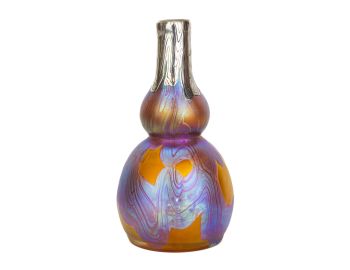
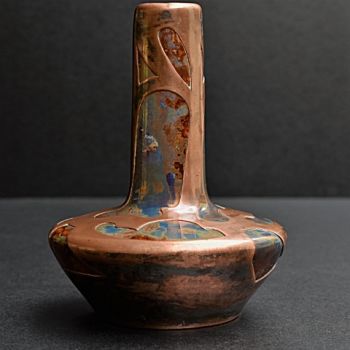
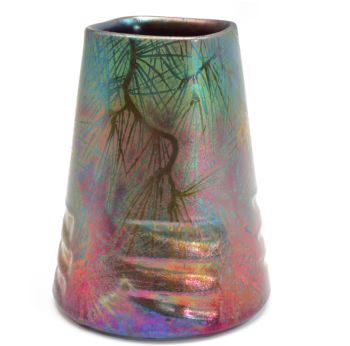
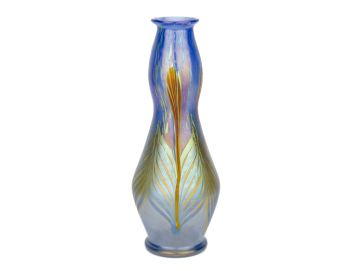
    The vase shown here is executed in Phänomen Genre 1/18, a decor introduced in 1901. This particular genre is easily recognizable by its distinct base color “Zephir”—a transparent, light green to greyish-turquoise tone that gives the piece a modern appearance. Over this base, deep blue vertically applied “tadpoles” are meticulously placed—stylized droplet-shaped elements with silvery iridescent stripes that reflect light in a captivating manner. This interplay of color and texture gives the vase a dynamic and strikingly contemporary character, remarkably ahead of its time.

    The form of the vase resembles a gourd or bottle shape, with the body transitioning smoothly into a slender neck and slightly flared mouth. The rim is clearly flame-finished, where the tips of the tadpoles are subtly fused into the edge—an expression of the high level of craftsmanship involved in the making of this piece. With its height of 25 cm, the vase provides an ideal canvas for the Phänomen Genre 1/18 décor; the elongated shape elegantly accentuates the vertical alignment of the tadpoles.

    Signature
    The underside of the vase features a perfectly polished pontil, a detail that is characteristic of high-quality Loetz productions from this period. Although this particular example is unsigned, the combination of décor, form, and execution unmistakably confirms its authenticity as a true Loetz creation.

    Afmetingen:
    Height: 25cm / 9.84”
    Diameter top: 5,5cm / 2.17”
    Diameter base: 10,5cm / 4.13“
    Condition: Mint

    Literature:
    Prestel – Böhmisch Glas 1880 – 1940 Band 1 Werkmonographie – Page 333.
    Hatje Cantz – Loetz Bohemian Glass 1880 – 1940 – Page 113 & 303
  • Sobre el artista

    La cristalería Loetz existió en Klostermuhle, Austria, durante poco más de cien años, a partir de 1840. Pero su apogeo fue durante la vida de Max Ritter Von Spaun, nieto del Johann Loetz original que había fundado la empresa.

    Von Spaun se hizo cargo de la empresa en 1879 y la dirigió hasta 1908, un año antes de su muerte. Fue asistido por Eduard Prochaska, su especialista técnico, y juntos inventaron, diseñaron y produjeron toda una serie de maravillosos nuevos tipos de vidrio, obteniendo varias patentes y ganando premios en todas las principales exposiciones mundiales durante la década de 1890 y los primeros años de el nuevo siglo.

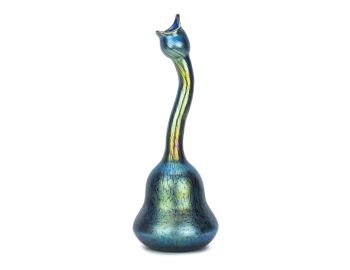
    La empresa Loetz se encontraba entre los líderes en diseño Art Nouveau y especialmente en vidrio artístico iridiscente. El vidrio "Papillon", como el jarrón de la izquierda, a veces se conoce hoy como vidrio "mancha de aceite". Otro colorante favorito de Loetz fue el vidrio irridizado con senderos tirados llamado vidrio "Fenómeno".

    Había jarrones irridizados con cintas de colores metálicos que serpenteaban sobre la superficie, y muchos diseños espectaculares con estelas aplicadas de hermosos colores, o simplemente sacadas del cuerpo del vidrio para formar asas o decoración.

    Alrededor de 1900, la compañía comenzó a colaborar con diseñadores externos, y algunos grandes artistas diseñaron piezas para Lotz, en particular Joseph Hofmann, Koloman Moser, Maria Kirchner y Hofstatter.

    En 1908 Loetz fue adquirido por el hijo de Max Von Spaun, también llamado Max, y aunque luchó financieramente (pasando por la quiebra en 1911 y nuevamente en 1931) hubo varios grandes diseñadores cuyo trabajo fue producido por Loetz durante esos años y a través del arte. período de deco. Estos incluyeron a Adolf Beckert y Michael Powolny.

¿Está interesado en comprar esta obra de arte?