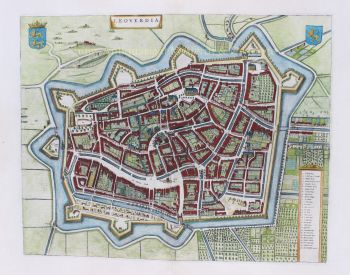
17TH CENTURY MAP OF LEIDEN 1652
Joan Blaeu
Papel
42 ⨯ 53 cm
€ 2.150
Inter-Antiquariaat Mefferdt & De Jonge
- Sobre la obra de arte"LUGDUNUM BATAVORUM vernacule Leyden." Copper engraving published in Amsterdam in 1649 by Joan Blaeu as part of his town book "Toneel der Steden van de Vereenighde Nederlanden" [Theatre of towns of the United Netherlands]. Coloured by a later hand. Verso: Latin text. Size: 42 x 53.7 cm. Leiden, the fourth-largest city in Holland, was a significant town in the 17th century, primarily due to the university founded there in 1575. Leiden was given this university as gratitude for its brave resistance against the Spaniards in the Eighty Years' War. The town was built around the Burcht, an artificial cone-shaped hill on which a circular tuffstone refuge castle was constructed in the 12th century. This castle stands where two branches of the Rhine converge, precisely in the middle of the town. The settlement developed as a dike village on the southern Rhine dike, the Breestraat, and became the center of trade and shipping in the rapidly developing agricultural surroundings. Remarkably, Leiden lacks large squares or marketplaces. At the time this map was made, Leiden was at the peak of its prosperity. Joan Blaeu writes (in Latin on the verso side of the map): the town is strong and well-built, equipped with sturdy gates, solid ramparts, and broad moats, making it well-defensible. Outside the walls, there is a wide moat beautifully planted with elms, providing a pleasant place for relaxation. Blaeu further notes that Leiden was next to Amsterdam, due to its recent expansions, the largest city in this province [Holland]. It had 89 streets and alleys and 102 stone bridges. (Be sure to watch the interesting video featuring a 3D version of the map.) The Amsterdam-based cartographer and publisher Joan Blaeu aimed to achieve the objectives of earlier publishers Abraham Ortelius and Georg Braun & Franz Hogenberg simultaneously by including a series of town books in his extensive world atlas. Blaeu's Toneel der Steden van de Vereenighde Nederlanden was published in Latin in 1649; the Dutch edition was printed in 1652. Some of the maps included in this work had been published in earlier atlases—21, for example, in Marcus van Boxhorn's Theatrum Hollandiae from 1632. Other maps were entirely newly created for Blaeu's town book. It is known that Blaeu wrote letters to city councils requesting maps and descriptions for inclusion in his work. Price: Euro 2.150,- (incl. frame)
- Sobre el artista
Joan Blaeu (1596-1673), nació el 23 de septiembre de 1596 en Alkmaar.
Fue un cartógrafo holandés nacido en Alkmaar. Siguió los pasos de su padre, el cartógrafo Willem Blaeu.
En 1620 se doctoró en derecho pero se incorporó a la obra de su padre. En 1635 publicaron el Atlas Novus (título completo: Theatrum orbis terrarum, sive, Atlas novus) en dos volúmenes. Joan y su hermano Cornelius se hicieron cargo del estudio después de la muerte de su padre en 1638. Joan se convirtió en el cartógrafo oficial de la Compañía Holandesa de las Indias Orientales.
El mapa del mundo de Blaeu, Nova et Accuratissima Terrarum Orbis Tabula, que incorpora los descubrimientos de Abel Tasman, se publicó en 1648. Este mapa fue revolucionario porque "representa el sistema solar de acuerdo con las teorías heliocéntricas de Nicolaus Copernicus, que muestran la Tierra girando alrededor el sol... Aunque el innovador libro de Copérnico Sobre las revoluciones de las esferas se imprimió por primera vez en 1543, poco más de un siglo antes, Blaeu fue el primer cartógrafo en incorporar esta revolucionaria teoría heliocéntrica en un mapa del mundo".
El mapa de Blaeu se copió para el mapa del mundo colocado en el pavimento del Groote Burger-Zaal del nuevo Ayuntamiento de Ámsterdam, diseñado por el arquitecto holandés Jacob van Campen (ahora el Palacio Real de Ámsterdam), en 1655.
La Hollandia Nova de Blaeu también se representó en su Archipelagus Orientalis sive Asiaticus publicado en 1659 en el Kurfürsten Atlas (Atlas del Gran Elector). y utilizado por Melchisédech Thévenot para producir su mapa, Hollandia Nova—Terre Australe (1664).
Como "Jean Blaeu", también publicó el volumen 12 "Le Grand Atlas, ou Cosmographie blaviane, en laquelle est exactement descritte la terre, la mer, et le ciel". Una edición está fechada en 1663. Era un folio (540 x 340 mm) y contenía 593 mapas y láminas grabados. En marzo de 2015, se puso a la venta una copia por 750.000 libras esterlinas.
Alrededor de 1649, Joan Blaeu publicó una colección de mapas de ciudades holandesas llamada Toonneel der Steeden (Vistas de ciudades). En 1651 fue votado en el consejo de Ámsterdam. En 1654 Joan publicó el primer atlas de Escocia, ideado por Timothy Pont. En 1662 reeditó el Atlas Novus, también conocido como Atlas Maior, en 11 volúmenes y uno para los océanos.
Se planeó una cosmología como su próximo proyecto, pero un incendio destruyó el estudio por completo en 1672.
Joan Blaeu murió en Amsterdam el año siguiente, 1673. Fue enterrado en Westerkerk en Amsterdam.

¿Está interesado en comprar esta obra de arte?
Artwork details
Related artworks
- 1 - 4 / 12
Artista Desconocido
Een Gotische zuidelijke Nederlanden wandklok1580 - 1590
Precio a consultarNico van den Assem restauratie
Artista Desconocido
Baroque Iberian Emerald Earrings, 18th Century Goldwork with 58 Emeralds1750
€ 7.250Adin Fine Antique Jewellery
curada porDanny Bree
Artista Desconocido
Antique Dutch still life flowers in vase1740 - 1800
Precio a consultarGallerease Selected
1 - 4 / 24Gobert Denis Chambon/ Jean Janvier, S.G. Longschamps
Magnificient antiek World map1754
€ 17.500Inter-Antiquariaat Mefferdt & De Jonge
curada porDanny Bree
1 - 4 / 24Jean-François Rauzier
Oasis Hotel - Limited edition of 8 2017
Precio a consultarVilla del Arte Galleries
Cornelis Anthonisz Theunissen
MUY RARO PRIMER MAPA IMPRESO DE ÁMSTERDAM, UNA CIUDAD EN ASCENSO1544
€ 125.000Inter-Antiquariaat Mefferdt & De Jonge
curada porDanny Bree
1 - 4 / 24Rene Rietmeyer
"Portrait of Lawrence Weiner, May 1999"1999
Precio a consultarEuropean Cultural Centre Collection
Rene Rietmeyer
"Germany, Saarland, April 2001"2001
Precio a consultarEuropean Cultural Centre Collection
1 - 4 / 24- 1 - 4 / 12


![RARE ARMORIAL MAP: LEO BRABANTIAE Lion of the most noble Duchy of Brabant] by Sibertus Waterloos](https://media-3.gallerease.com/images/325cc033-a3b6-495f-9da8-6d06caf29b14/350x350/rare-armorial-map-leo-brabantiae-lion-of-the-most-noble-duchy-of-brabant.jpg)