Rotterdam - Adriaen Schoonebeek + Jacobus Allard by Artista Desconocido
Scroll to zoom, click for slideshow

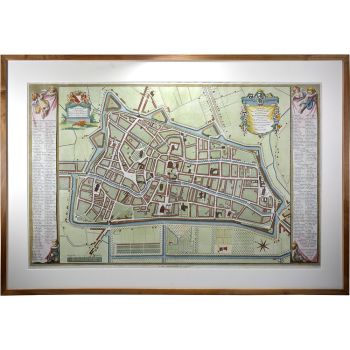
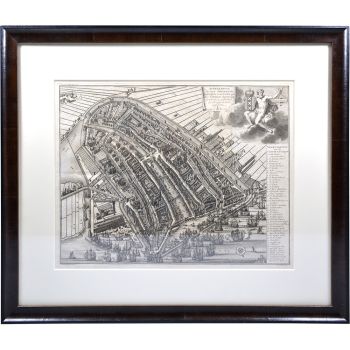
Rotterdam - Adriaen Schoonebeek + Jacobus Allard 1689

Artista Desconocido

ImpresiónGrabado
46 ⨯ 55 cm
€ 4.150

Inter-Antiquariaat Mefferdt & De Jonge

  • Sobre la obra de arte
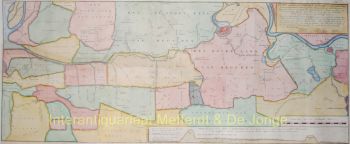
    RICHLY DECORATED MAP OF ROTTERDAM “Tabula Rotterdodami Novissima”, copper engraving by Adriaen Schoonebeek, 2nd state (of 4) published by Jacobus Allard approx. 1689, coloured by a later hand. Size. 46 x 55,5 cm. The map shows us Rotterdam on a scale of approximately 1: 5000. Each house, bridge, windmill, church, etc. is shown in great detail. There are about twenty boats and ships in the Maas in front of the city, and many more in the wide canals. The gardens, fields and scattered houses and windmills just outside the surrounding city moat are also depicted. The map was made around 1689 by the Amsterdam artist and engraver Adriaen Schoonebeek. He had learned his skills from Romeijn de Hooghe who was undoubtedly responsible for the beautiful etched decorations, of the map. Jacobus Allard published the map in its second state here. His older brother Carel Allard extensively updated the map and published it for anew in 1708. The legends on both sides are lined with putti, flowers and a rich harvest. Under the City Triangle there is a rich allegorical decoration. In the middle the city maiden bears a spear and Rotterdam coat of arms, Mercury indicates the commercial spirit of the city, Neptune indicates its location on the water; Minerva the goddess of wisdom carries a spear with a banner and “SPQR” [the senate and people of Rotterdam]; an Ottoman with a camel, an Indian, a lion, an African with an ostrich indicate relations with all corners of the world; the satyr seducing the river nymph (far left) and the Horn of Plenty indicate prosperity; and the Maas also produces fish. Despite the extensive legends, that give the impression of reliability, the map does not provide up-to-date information. As often the case, the engraver used an older copper plate from around 1677 for this issue of the city map. He decorated the map, added new numbers to the legend and finally gave the map his name and address. Price: 4.150,-  
  • Sobre el artista

    Puede suceder que un artista o creador sea desconocido.

    Algunas obras no deben determinarse por quién está hecho o por (un grupo de) artesanos. Algunos ejemplos son estatuas de la Antigüedad, muebles, espejos o firmas que no son claras o legibles, pero también algunas obras no están firmadas en absoluto.

    También puedes encontrar la siguiente descripción:

    •"Atribuido a …." En su opinión, probablemente una obra del artista, al menos en parte.

    •“Estudio de….” o “Taller de” En su opinión, una obra ejecutada en el estudio o taller del artista, posiblemente bajo su supervisión

    •“Círculo de…” En su opinión, una obra del período del artista que muestra su influencia, estrechamente asociado con el artista pero no necesariamente su alumno.

    •"Estilo de …." o “Seguidor de…”. En su opinión, una obra ejecutada al estilo del artista pero no necesariamente por un alumno; puede ser contemporáneo o casi contemporáneo

    •"Manera de …." En su opinión una obra al estilo del artista pero de fecha posterior

    •"Después …." En su opinión, una copia (de cualquier fecha) de una obra del artista

    •“Firmado…”, “Fechado…” o “Inscrito” En su opinión, la obra ha sido firmada/fechada/inscrita por el artista. La adición de un signo de interrogación indica un elemento de duda.

    •“Con firma…”, “Con fecha…”, “Con inscripción…” o “Lleva firma/fecha/inscripción” en su opinión la firma/fecha/inscripción ha sido añadida por alguien que no es el artista

¿Está interesado en comprar esta obra de arte?

Artwork details