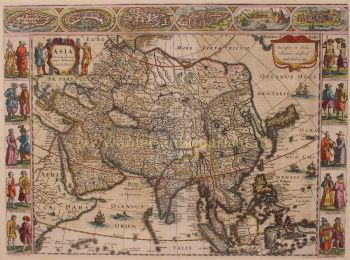
Asia 1638 - 1642
Jodocus Hondius
PapelImpresión
45 ⨯ 56 cm
€ 3.450
Inter-Antiquariaat Mefferdt & De Jonge
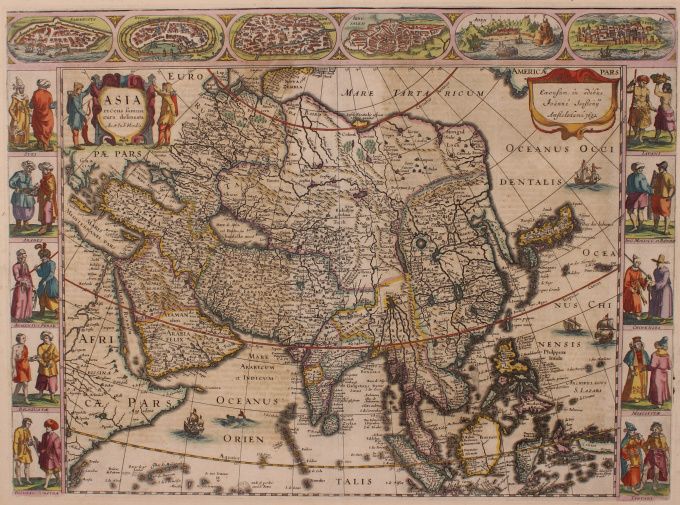
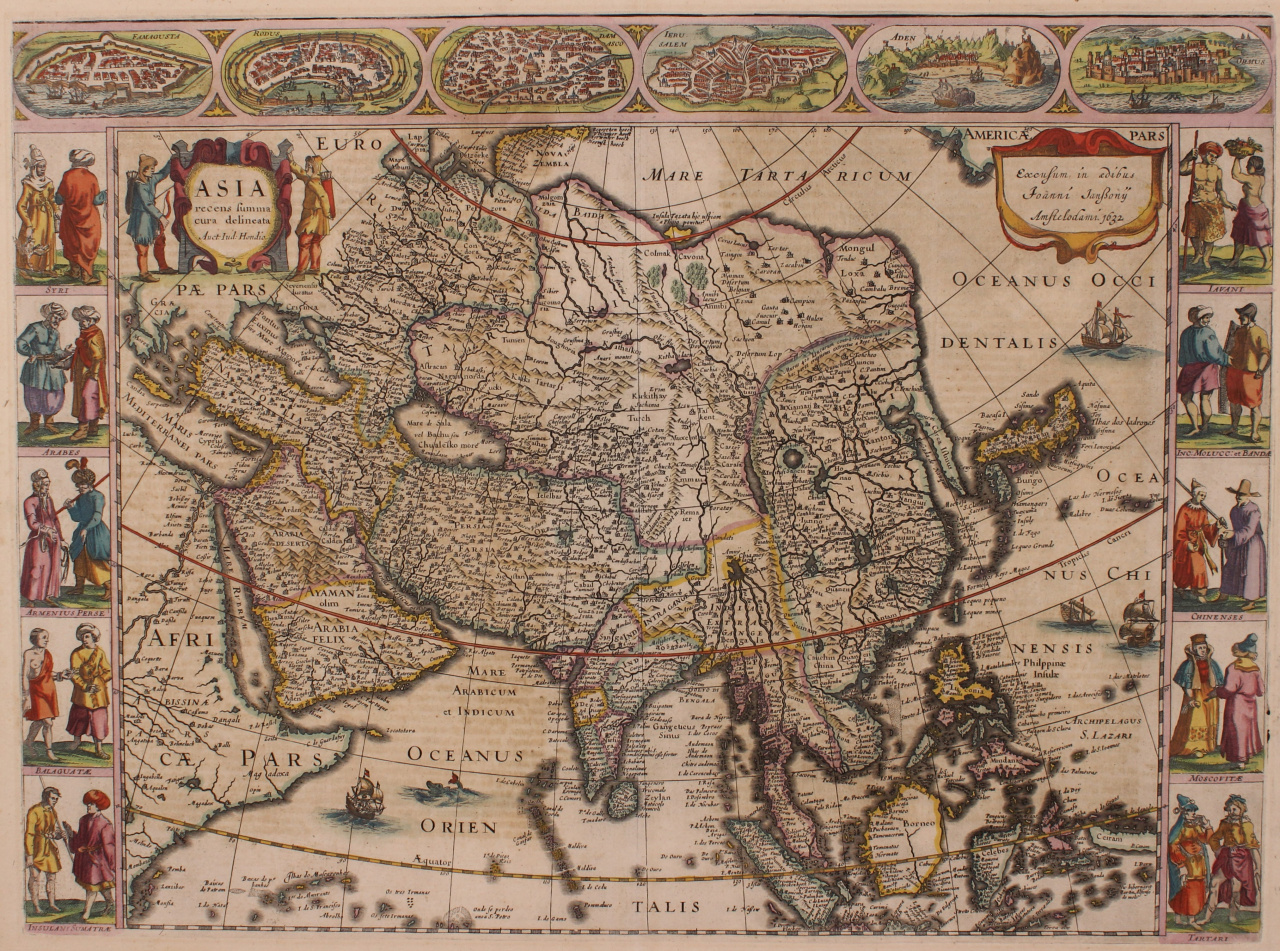
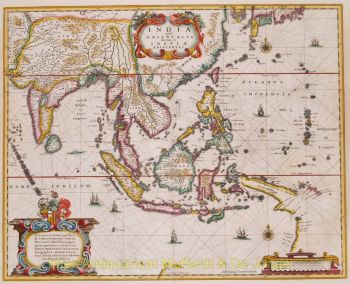
- Sobre la obra de arteFINE RARE CARTE À FIGURES MAP OF ASIA "Asia recens summa cura delineata Auct. Iud: Hondio". Copper engraving by Jodocus Hondius, published in Amsterdam between 1638-1642 (4th state) by Jan Jansson. With original hand colouring. Verso: German text. Size: 45,5 x 56,5 cm. This highly attractive map embraces all of Asia. The Middle East is very well formed, although the Caspian Sea has the egg-like form it maintained on maps until the 1730s. The Arabian Peninsula is well defined, based on Portuguese sources, and India takes its form after the maps of the Dutch adventurer, Jan Huygen van Linschoten (1596), which, in turn, borrowed from Portuguese sources. Southeast Asia and the Indonesian Archipelago are derived from charts made for the Dutch East India Company (VOC), while China is derived from Jesuit sources, although Korea is an oddly elongated peninsula. The geography of the region would remain an enigma to Europeans until the early 18th Century. Japan's Honshu and Kyushu are recognizable, although the area further to the northeast remains a vast mystery. True to the carte à figures' style, which was the hallmark of the great contemporary period of Dutch Baroque cartography, the map is surrounded on four sides by registers of fine vignettes. Along the top of the map are views of Famagusta (Cyprus), Rhodes (Greece), Damascus, Jerusalem, Aden and Hormuz (Persia). Along the left side of the map are depictions of people in local costume including Syrians, Arabs, Armenians & Persians, Indians, and Sumatrans. On the right side are depictions that include Javanese, Moluccans & Bandans, Chinese, Russians and Tartars. Along the bottom of the map there are further town views of Dutch trading posts Goa (India), Calcutta (Bengal/India), Kandy (Ceylon), Bantam, Gammalamme (Moluccas) and Macao. In addition the map is embellished by a fine title cartouche and ships and sea monsters in the seas. The map was originally conceived by Jodocus Hondius the Younger (1594-1629), whose eponymous father played a large part in the rise of Amsterdam as the dominant cartographic production centre in the 17th Century. The present edition of the map is by Jan Jansson (1588-1664), who married Jodocus the Younger's sister Elizabeth. He transformed the Hondius firm into a powerhouse of geographical publications. Jansson most notably published the Atlas Novus (1638), and the Atlas Major (1660), the 11 volumes of which included a town atlas, a hydrographic atlas, an atlas of the ancient world, and Andreas Cellarius' incomparable celestial atlas. Jansson's works were rivalled only by those of his arch-nemesis Joan Blaeu. The present map is one of the finest depictions of Asia from the apogee of Dutch cartography. Price: Euro 3.450,-
- Sobre el artista
Jodocus Hondius (17 de octubre de 1563 - 12 de febrero de 1612), también conocido por la forma latinizada de su nombre neerlandés, Joost de Hondt, fue un grabador y cartógrafo flamenco y una de las figuras más destacadas de la Edad de Oro de la cartografía neerlandesa. Para distinguirlo de su hijo, a menudo se le conoce como Jodocus Hondius el Viejo.
Hondius saltó a la fama gracias a su excepcional habilidad para combinar la técnica del grabado con la erudición geográfica. Es conocido sobre todo por sus primeros e influyentes mapas de Europa y el Nuevo Mundo, que contribuyeron a moldear la comprensión visual europea de los territorios recién explorados a principios del siglo XVII. Sus mapas se caracterizan por su claridad, precisión y un rico detalle decorativo, cualidades que los convirtieron en documentos científicos de prestigio y obras de arte muy codiciadas.
Un momento crucial en la carrera de Hondius fue la adquisición de las planchas de impresión originales de Gerardus Mercator. En una época en que la reputación de Mercator comenzaba a decaer, Hondius republicó y amplió estas láminas, integrando sus propias revisiones y los nuevos conocimientos geográficos disponibles. Este acto no solo revivió el legado de Mercator, sino que también consolidó su influencia duradera, dando lugar a los célebres atlas Mercator-Hondius que dominarían la cartografía europea durante décadas.
Además de la cartografía, Hondius también fue un hábil grabador de retratos. Sus retratos de Francis Drake se encuentran entre las representaciones visuales más reconocibles del famoso navegante inglés, lo que demuestra aún más la versatilidad y el alcance cultural de Hondius.
Como una de las figuras centrales de la Edad de Oro cartográfica holandesa (c. 1570-1670), Hondius desempeñó un papel crucial en el establecimiento de Ámsterdam como el principal centro de la cartografía en la Europa del siglo XVII. Su obra conectó el arte, la ciencia y el comercio, moldeando la forma en que se cartografiaba, entendía e imaginaba el mundo. Hoy en día, Jodocus Hondius el Viejo es recordado como un maestro grabador, un editor innovador y un arquitecto clave de la historia cartográfica moderna.

¿Está interesado en comprar esta obra de arte?
Artwork details
Related artworks
- 1 - 4 / 6
- 1 - 4 / 24
Gobert Denis Chambon/ Jean Janvier, S.G. Longschamps
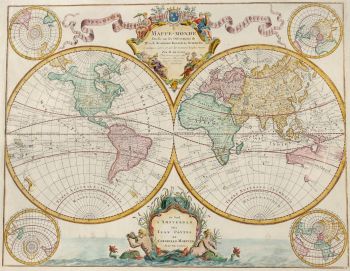
Magnificient antiek World map1754
€ 17.500Inter-Antiquariaat Mefferdt & De Jonge
curada porDanny Bree
Cornelis Anthonisz Theunissen
MUY RARO PRIMER MAPA IMPRESO DE ÁMSTERDAM, UNA CIUDAD EN ASCENSO1544
€ 125.000Inter-Antiquariaat Mefferdt & De Jonge
curada porDanny Bree
Jean-François Rauzier
Oasis Hotel - Limited edition of 8 2017
Precio a consultarVilla del Arte Galleries
1 - 4 / 24- 1 - 4 / 24
- 1 - 4 / 12